DMZ Tour from Seoul (2026): Cost, Booking, What You See
“The Third Tunnel, a look across into North Korea, and the one stretch of border you can reach without a tour.”
The DMZ sits about an hour north of Seoul, and it is the one major sight in Korea that mostly cannot be visited independently. The four-kilometer-wide strip separating the two Koreas is ringed by a civilian control zone with military checkpoints, and access to the sites people actually come to see — the infiltration tunnel, the observatory looking across the border — runs exclusively through licensed group tours. That changes how planning works: instead of deciding how to get somewhere, the real decisions are which tour format to book, what each one actually includes, and whether the parts of the border that don't require a tour are worth a separate trip.
This guide covers those decisions in order: the half-day versus full-day formats and what they cost in 2026, what the standard stops involve, the current status of the JSA at Panmunjom, how booking works, and the one corner of the border — Imjingak — that anyone can reach by train without booking anything at all.
Can You Visit the DMZ Without a Tour?
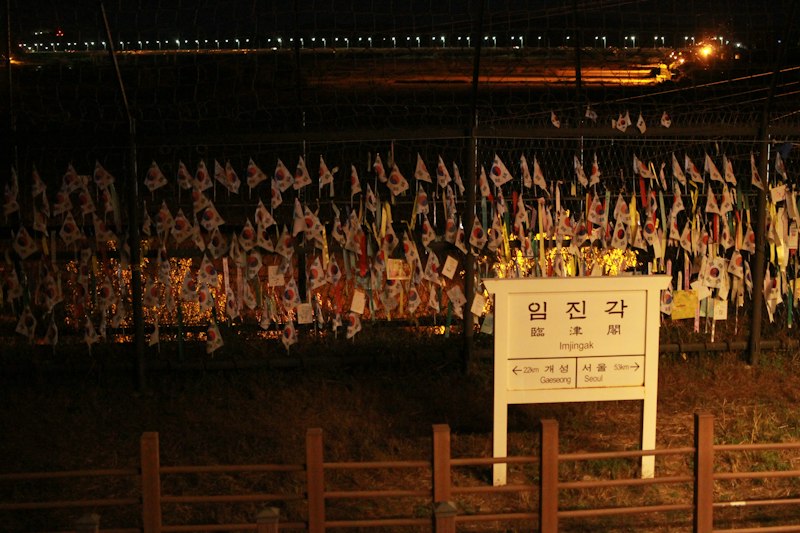
For the controlled zone itself, no. Entry past the civilian control line checkpoints is limited to licensed operators running fixed itineraries with passport checks on board, and there is no version of showing up at the Third Tunnel or Dora Observatory in a rental car or taxi. But the answer isn't a complete no: Imjingak, the border park where the civilian road north effectively ends, sits just outside the control line and is open to anyone, free, with its own train and bus connections from Seoul. It has the Freedom Bridge, war memorials, the famous ribbon-covered fence, and a gondola that crosses the Imjin River into the civilian control zone with nothing more than an ID check. The full details are further down this page — for many travelers short on time or budget, Imjingak alone is a meaningful visit.
Half-Day vs Full-Day DMZ Tours
| Format | Price (2026) | Stops | Back in Seoul |
|---|---|---|---|
| Half-day | ₩50,000–60,000 | Imjingak, Third Tunnel, Dora Observatory, Unification Village | Around 13:30 |
| Full-day | ₩70,000–80,000 | Everything above, plus Gamaksan Suspension Bridge | 16:00–16:30 |
Both formats cover the same core border sites; the full-day version adds the Gamaksan Suspension Bridge, a long pedestrian bridge strung across a mountain valley south of the border, reached by a short fifteen-minute hike. Prices include round-trip transport from Seoul and admission to the tunnel and observatory, which is why even the half-day figure looks high next to a regular day trip — there is no cheaper independent version to compare it against.
The half-day format is the right default for most first visits. It returns to Seoul by early afternoon, which leaves a real half day for the city, and the border sites themselves are the reason anyone makes this trip. The full-day version earns its extra cost mainly for travelers who want the trip to feel like a complete day out rather than a morning, or who'd rate a mountain suspension bridge as a genuine second attraction rather than filler between stops.
What You Actually See on a DMZ Tour
The Third Infiltration Tunnel is the stop the tours are built around. Discovered in 1978, it is one of four tunnels found dug under the border from the North, wide enough to move troops through, and the only part of the DMZ experience that physically takes you under the ground the conflict is about. Visiting means walking down a steep access ramp, hard hat on, and back up the same slope — manageable for most fitness levels, but genuinely steep, and cameras stay outside. It is also cool underground year-round, which makes it the one stop unaffected by weather.
Dora Observatory is the counterweight: a hilltop viewing deck with mounted binoculars where, on a clear day, the view runs across the zone into North Korea — the flagpole and empty buildings of Kijong-dong, the so-called Propaganda Village, and on the clearest days the outskirts of Kaesong beyond it. How much you see depends heavily on visibility, which is the main reason identical tours produce very different reviews.
Unification Village, or Tongilchon, is a short final stop in a farming village inside the civilian control zone, where residents grow ginseng and soybeans on land most Koreans cannot enter. It functions partly as a rest-and-shopping stop, and it is easy to dismiss on paper, but the ordinariness of a working village inside a military control zone is its own kind of point.
Tours also stop at Imjingak on the way in or out — the same park covered below that you can reach on your own.
What About the JSA (Panmunjom)?
The JSA — the blue conference huts where soldiers from both sides stand meters apart, the image most people picture when they think of the DMZ — has been closed to civilian tours since 2023, after an American soldier crossed into the North during a tour. Access has never returned to a reliable schedule since: brief reopenings have been followed by new suspensions, including another halt in late 2025, and the UN Command has indicated that even permitted visits no longer enter the conference buildings themselves.
The practical translation for 2026: book a regular DMZ tour and treat the JSA as unavailable. If an operator advertises JSA access, read the fine print — departures depend on political conditions, cancellations can come the same morning, and no operator can guarantee entry. Nothing about the standard DMZ tour described on this page depends on JSA access.
How to Book a DMZ Tour
Planning a trip to Korea?
A DMZ tour eats a whole day. The planner fits it around the rest of your Seoul time instead of on top of it. No sign-up needed.
Build My Korea Plan →Booking a few days ahead is usually enough outside holidays and spring blossom weekends, when dates genuinely sell out. Tours depart Seoul early — typically between 7:00 and 8:30 from pickup points around City Hall, Myeongdong, and Hongdae — and most do not run on Mondays, when the border sites are closed.
The one hard requirement is a passport. Identity checks happen at the checkpoint entering the civilian control zone, the headcount on the bus has to match the manifest submitted in advance, and operators will refuse boarding without the physical document — a photo or photocopy does not work. This is also why bookings ask for passport details upfront. There is no strict dress code on regular DMZ tours; that rule belonged to JSA visits and gets repeated online long after it stopped being relevant.
Visiting Imjingak Without a Tour
Imjingak is the free, no-permission-needed version of the border, and getting there is a normal transit trip: the Gyeongui-Jungang Line runs from central Seoul to Munsan in about an hour and twenty minutes on a T-money card, and from Munsan a local bus (058B) or a ten-minute taxi covers the last stretch to the park. A shuttle train also runs from Munsan to Imjingang Station, directly at the park entrance, but only a handful of times a day — twice on weekdays — so check the schedule rather than planning around it. The Seoul transportation guide covers the fare system that applies to the whole trip.
The park itself concentrates more history per square meter than the tour stops: the Freedom Bridge that returned prisoners of war in 1953, a steam locomotive left riddled with bullet holes since the war, memorial altars where separated families hold rites facing north, and the fence line covered in ribbons left by visitors. The Peace Gondola crosses the Imjin River from the park into the civilian control zone — the first cable car anywhere to cross into one — and requires only a passport or ID and a short access form, no tour. It runs Tuesday through Sunday from 8:00 to 20:00, and closes earlier, at 18:00, on Mondays.
What Imjingak cannot give you is the tunnel or the view into the North — those stay behind the checkpoints. The honest framing: Imjingak is the border as Koreans experience it, a place of memorials and family history; the tour is the border as a military line. Travelers with the budget and an early morning to spare should take the tour. Travelers with neither still get something real at Imjingak for the price of a subway fare.
Practical Notes
Visibility decides how much Dora Observatory delivers, and clear, dry days — common in autumn and winter — beat hazy summer mornings by a wide margin. If the forecast shows fog or fine dust, and your dates are flexible, wait.
Carry the physical passport on tour day even if the booking already has your details; forgetting it is the most common way this trip fails. For broader pre-trip logistics — passport validity, the e-Arrival Card, apps worth installing before landing — the Korea trip checklist covers the full sequence.
The DMZ pairs naturally with an unhurried second half of the day in Seoul, since half-day tours return by early afternoon. Travelers who'd rather spend a full day out of the city on something lighter can compare the Suwon Hwaseong day trip — the opposite kind of border wall, and one you can walk on top of.
Frequently Asked Questions
Can you visit the DMZ without a tour?
The controlled zone itself requires a licensed group tour — there is no independent access to the Third Tunnel or Dora Observatory. But Imjingak, the border park at the edge of the civilian control line, is open to anyone: reachable by Gyeongui-Jungang Line train to Munsan plus a short bus or taxi ride, free to enter, with a gondola crossing into the civilian control zone that needs only an ID check.
How much does a DMZ tour from Seoul cost in 2026?
Half-day tours run roughly ₩50,000–60,000 and return to Seoul around 13:30. Full-day tours cost about ₩70,000–80,000 and add the Gamaksan Suspension Bridge, returning between 16:00 and 16:30. Prices include round-trip transport from Seoul and admission to the Third Tunnel and Dora Observatory.
Can you visit the JSA (Panmunjom) in 2026?
Effectively no. Civilian JSA tours have been suspended since 2023 and have not resumed on a reliable schedule — brief reopenings have been followed by new suspensions, and even permitted visits no longer enter the blue conference buildings. Book a regular DMZ tour and treat any JSA availability as a bonus, not a plan.
Do I need my passport for a DMZ tour?
Yes, the physical passport. Identity checks happen at the checkpoint entering the civilian control zone, the bus headcount must match the manifest submitted in advance, and operators will refuse boarding without it. A photo or photocopy is not accepted.
Is visiting the DMZ safe?
Yes. Tours run daily through the civilian-accessible areas under military coordination, and the itinerary keeps groups inside controlled tourist zones the entire time. The practical requirements are carrying your passport, staying with the group, and following photography restrictions at marked points.
Make a plan that fits your trip
A DMZ tour eats a whole day. The planner fits it around the rest of your Seoul time instead of on top of it. No sign-up needed.
Build My Korea Plan →