Busan Travel Guide 2026: First-Time Visitor Essentials
“Beaches, mountains, seafood, and a pace Seoul never learned — here is how to do Busan right the first time.”
Busan Travel Guide 2026: Everything a First-Time Visitor Needs to Know
Seoul is neon and efficiency. It moves at a pace that keeps you alert at all hours, feeds you at midnight, and rewards the itinerary. Busan is something else entirely — salt air and seafood, a city built into mountains that drop into the sea, a place where the right response to a good meal is to sit down and order one more round rather than check the next item on the list.
Korea's second city draws around three million international visitors a year, and that number has been climbing every year since 2022. Eighty percent of those visitors cite food as the primary reason for coming. That statistic is worth sitting with. People are not flying to Busan for a beach checklist. They are coming back for the dwaeji gukbap, for the early morning chaos at Jagalchi Fish Market, for a version of Korea that Seoul's relentless forward momentum has largely left behind.
This guide covers everything you need to know for your first visit: how to get here, where to stay, what to see, and — most importantly — what to eat.
How to Get from Seoul to Busan
The KTX high-speed train is the correct answer for almost every traveler. The journey takes 2.5 hours from Seoul Station to Busan Station, runs multiple times per hour throughout the day, and costs around $30–50 depending on timing and class. You arrive in the center of Busan with no airport transfer to manage and no luggage hold to wait for. Book tickets in advance through Korail or Klook, especially for Friday evenings and weekend mornings when seats sell out.
The express bus from Seoul's Central City Terminal takes four to five hours and costs less, but the time difference rarely justifies the saving unless your budget is tight. A domestic flight from Gimpo to Gimhae takes one hour in the air but add two hours for airport check-in and transfers on both ends and the advantage disappears almost entirely.
For most visitors, the decision between Busan and other Korean destinations comes before the transport question. The Busan vs Jeju guide covers which destination suits which kind of traveler, with itinerary options for doing both in one trip.
Where to Stay in Busan
Seomyeon
Seomyeon is the best base for first-time visitors. It sits at the center of Busan's subway network, which means everything in the city is within reasonable transit distance. The neighborhood has strong dining and nightlife, affordable accommodation across all budget levels, and enough activity that you can fill an evening without a plan. It is not a beach neighborhood, but it is the most practical starting point.
Haeundae
Haeundae is where Busan's beach hotels concentrate — large properties backing directly onto Korea's most famous stretch of sand. Accommodation here runs more expensive than the rest of the city, but the location makes mornings and evenings easy. Walk out, swim, watch the Diamond Bridge light up from the water. If beach access matters more than transit convenience, Haeundae is the right choice.
Nampo and BIFF Square
Nampo sits near Jagalchi Fish Market and BIFF Square — Busan's traditional commercial and street food center. Accommodation here skews older and more affordable. The tradeoff is a longer commute to Haeundae, but the neighborhood rewards early mornings: the fish market is at its best before 9am, and the street food energy around BIFF Square picks up from late afternoon.
Gwangalli
Gwangalli is Busan's nightlife district, built around a beach that locals tend to prefer over Haeundae for its quieter daytime atmosphere. The view of Gwangan Bridge — lit up at night with a shifting color display — is one of the best free spectacles in any Korean city. Accommodation is more limited here, but the area suits travelers who want beach proximity without the Haeundae crowds.
Must-See Attractions in Busan
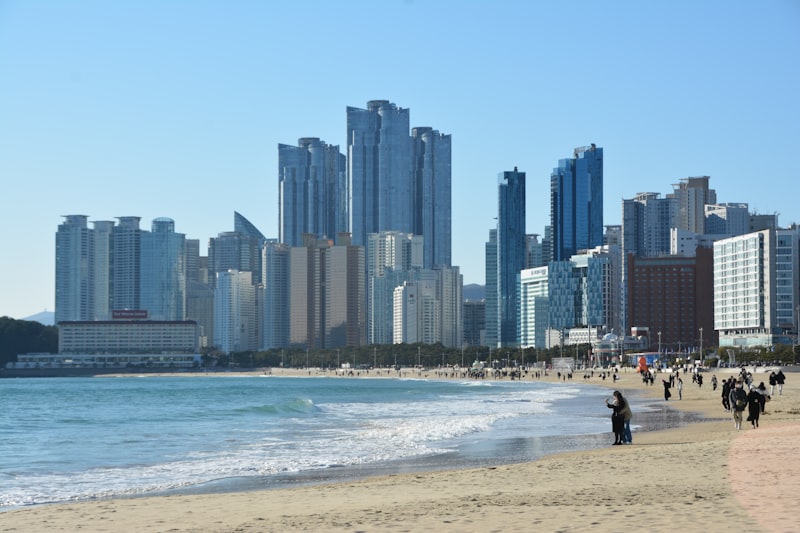
Haeundae Beach needs no elaborate introduction. It is Korea's most visited beach: 1.5 kilometers of sand backed by high-rise hotels and a dense stretch of seafood restaurants. The water is clean, the infrastructure is good, and the crowds in summer are substantial. Go early in the morning if you want the sand without the density.
Gwangalli Beach operates at a different register. Shorter, slightly less polished, with a neighborhood feel that Haeundae has traded away as it grew. The beach bar culture here runs later and the view across the water to Gwangan Bridge — which changes color patterns after dark — gives Gwangalli evenings a specific quality that is hard to replicate anywhere else in Korea.
Gamcheon Culture Village is a hillside neighborhood above the port where brightly painted houses step down toward the water in tight, overlapping layers. It functions as an open-air gallery, with murals, installations, and small art spaces woven between active residences. Go before 11am on any day — the village becomes genuinely crowded by midday, and the narrow lanes lose their atmosphere under the weight of tour groups.
Haedong Yonggungsa Temple sits on a rocky coastal headland at the city's northeastern edge, with the sea breaking on three sides. Most Korean Buddhist temples are set in mountain forests; this one was built in 1376 directly into the coastline, and the contrast between the traditional architecture and the open ocean is dramatic in a way that photographs underrepresent. The approach at sunrise, when the light hits the water and most tour buses have not yet arrived, is one of the better early mornings available in Korea.
Jagalchi Fish Market covers several city blocks near Nampo, making it Korea's largest seafood market. The outdoor vendors are active from early morning; the indoor floors house raw fish restaurants where you can point at what you want and have it prepared at your table. The right time to visit is between 8 and 10am, when the selection is at its widest and the energy is at its most concentrated.
BIFF Square — named for the Busan International Film Festival that has used this stretch since 1996 — is a pedestrian strip lined with street food stalls, cinema-related plaques set into the pavement, and the kind of local commercial energy that makes a neighborhood feel inhabited rather than performed.
For a deeper look at everything the city has to offer beyond this list, the Busan city guide covers neighborhoods, day trips, and seasonal events in full detail.
What to Eat in Busan
Food is the argument for Busan that sells the city better than any photograph of Haeundae.
Dwaeji gukbap (돼지국밥) is Busan's answer to Seoul's rich stew culture — a clear but intensely flavored pork bone soup served with rice and a spread of condiments: salted shrimp, chopped green onion, fermented radish. It is eaten at every hour, including 2am, by locals who treat it the way Parisians treat coffee. Order at any dedicated dwaeji gukbap restaurant near Seomyeon. The version at a place where the fluorescent lights are slightly too bright and the tables are shared is usually the correct version.
Milmyeon (밀면) is a cold wheat noodle dish specific to Busan — a post-Korean War invention born from American wheat flour aid and local adaptation. It shares the cold noodle format with Pyongyang naengmyeon but has a lighter, slightly sweeter broth. On a hot afternoon, it is one of the most refreshing things you can eat in Korea.
Ssiat hotteok (씨앗호떡) is the Busan variant of the sweet pancake found across Korea, filled with sunflower seeds, pumpkin seeds, and brown sugar. The seed mixture gives it a texture and depth that the Seoul version — which typically contains sugar and cinnamon alone — does not have. Find it at the stalls near BIFF Square and Gukje Market.
At Jagalchi Market, the outdoor vendors sell grilled shellfish, raw sea urchin, fresh crab, and sea cucumber alongside the morning catch. The format at most outdoor stalls is direct: choose what you want, pay per piece or per weight, and eat at the plastic tables nearby. No reservation required.
Agujjim (아구찜) is a braised monkfish dish that belongs to Busan in the same way dwaeji gukbap does — a product of the city's fishing culture and its appetite for heat. Monkfish is cooked with a thick layer of bean sprouts in a gochujang-based sauce until the broth reduces into something deeply spicy and savory. The dish arrives still bubbling in a clay pot; stir the bean sprouts up from the bottom and eat everything together. The Choryang neighborhood, just east of Busan Station, has a cluster of dedicated agujjim restaurants that have been running for decades.
Dongnae pajeon (동래파전) is a thick, pan-fried scallion pancake from the Dongnae district in Busan's northern neighborhoods. Unlike the thinner Seoul-style version, Dongnae pajeon is built with oysters or other local seafood folded into the batter, giving it a richer texture and a denser chew. The dish has been made in this area for centuries — local tradition connects it to the Joseon royal court, which received it as a regional tribute. Traditional Korean restaurants in the Oncheonjang hot spring area have kept it on the menu without interruption.
Neighborhoods to Explore in Busan
Haeundae (해운대) is the district most international visitors encounter first — a long stretch of beach backed by high-rise hotels, seafood restaurants, and the Busan Aquarium. The neighborhood rewards early mornings: the sand is quiet before 9am, the coffee shops open before the crowds arrive, and the coastal light makes the walk along the waterfront genuinely good. By midsummer afternoon it becomes one of the most crowded beaches in Asia, which tells you both how compelling it is and when to leave.
Gamcheon Culture Village (감천문화마을) climbs a hillside above the port in a dense, overlapping arrangement of pastel-painted houses originally built for Korean War refugees in the 1950s. The community gradually transformed itself into an open-air art space, with murals by local artists, small galleries set into residential lanes, and a map-led walking route most visitors complete in about ninety minutes. Arrive before 10am to see the village without the tour group density that accumulates through the morning.
Nampo-dong and BIFF Square (남포동) form Busan's traditional commercial center — the neighborhood that predates the resort hotels and the international visitor infrastructure. BIFF Square takes its name from the Busan International Film Festival, which has used this stretch of road since 1996; handprints of Korean cinema figures are embedded in the pavement. The surrounding streets are dense with street food stalls, affordable clothing shops, and local commercial activity that makes the area feel inhabited rather than constructed for visitors.
Jagalchi (자갈치) is less a neighborhood than a sustained atmosphere: Korea's largest fish market, spread across several blocks near the port, operating at full intensity from before sunrise. The outdoor vendors are the main event — stalls selling live seafood from tanks, grilled shellfish on demand, sea creatures displayed in varieties that most visitors will not immediately recognize. The market has no particular interest in presenting itself for tourism, which is exactly what makes it worth going.
Getting Around Busan
Planning a trip to Busan?
Answer a few quick questions and get a personalized day-by-day itinerary — cities, food, and transit included. No sign-up needed.
Build My Busan Plan →Busan's subway covers four lines and reaches all major attractions: Haeundae, Seomyeon, Nampo, Jagalchi, and the main bus and train terminals. The T-Money card you loaded in Seoul works here without any adjustment — tap and go. Fares are comparable to Seoul and the system is clean and reliable.
Kakao T handles taxi requests throughout the city. Busan taxis are slightly cheaper than Seoul equivalents, and most drivers are familiar enough with the major tourist destinations that language barriers are minimal. For Haedong Yonggungsa Temple, which sits beyond convenient subway reach, a taxi or the 181 bus from Haeundae are the practical options.
Haeundae, Nampo-dong, and Seomyeon are all walkable within their own areas. The challenge in Busan is the hills — Gamcheon Village in particular involves significant climbing, and comfortable shoes matter more here than in Seoul's flatter districts.
Busan vs Seoul: What Is Actually Different
The difference is not only the ocean, though the ocean is significant. Seoul has no coastline. Busan has two major beaches, a harbor, a working fish market that feeds a city of 3.5 million, and a skyline that competes with the mountains behind it rather than simply rising from flat ground.
The pace is different. Busan operates without Seoul's sense of urgency. Restaurants stay open later without the implicit pressure to turn the table. Conversations run longer. The local dialect — a distinct satoori that sounds rougher and more direct to ears trained on Seoul Korean — reflects a city that has always operated slightly outside the capital's gravitational pull.
The cost is noticeably lower. Accommodation in equivalent categories runs 20–30% less than Seoul. Street food and local restaurants are cheaper. For a detailed budget comparison across both cities and other Korean destinations, the Korea Travel Budget Guide 2026 covers daily spending at three levels.
The tourist infrastructure is thinner. English menus are less common outside of Haeundae. Signage is more likely to be Korean only. This is a feature as much as a limitation — it means the city has not yet reorganized itself primarily around foreign visitor expectations, which is precisely what gives it its character.
How Many Days Do You Need in Busan
Two days is enough to cover the major bases: Haeundae in the morning, Gamcheon in the late morning before crowds arrive, Jagalchi for lunch, Gwangalli at night. A second day adds the KTX to Gyeongju for a day trip — an hour each way, with one of Korea's densest concentrations of UNESCO heritage sites in between — and Haedong Yonggungsa at sunrise before departure.
Three days allows for a slower rhythm: a morning at the fish market followed by a long dwaeji gukbap lunch, an afternoon walking Seomyeon without a destination, an evening at Gwangalli with no particular plan beyond watching the bridge change color. This is the version of Busan that converts visitors into people who come back.
Four or five days opens up the coastal hiking trails above Haeundae, the smaller beaches east of the city, and the kind of off-schedule wandering that Busan rewards more than most Korean destinations.
Best Time to Visit Busan
Busan's climate differs from Seoul's in ways that matter for planning. The city is coastal and sits slightly warmer year-round, with summers moderated by sea breezes and winters that stay above freezing on most days.
| Season | Highlights | Note |
|---|---|---|
| Spring (Mar–May) | Cherry blossoms, mild weather, active markets | Peak season — book accommodation early |
| Summer (Jun–Aug) | Beach season at Haeundae and Gwangalli | Hot, humid — beaches peak crowd in July–August |
| Autumn (Sep–Nov) | Best weather, BIFF film festival in October | Recommended for first-timers |
| Winter (Dec–Feb) | Quiet city, full seafood season, coastal walks | Cold but rarely snowy — budget-friendly rates |
Spring and autumn are the most forgiving seasons for a first visit. The city is active without being overwhelmed, and the moderate temperatures make walking — which Busan requires more of than Seoul, given its hills — genuinely comfortable. The Busan International Film Festival in October brings the city's cultural energy to an unusual peak, though accommodation near the venues fills up well in advance during festival week.
Summer brings Busan its beach identity, but the crowd levels at Haeundae in late July and August are worth understanding before you book. The water is warm and clean; the experience around it — finding space on the sand, moving through the crowds — is less controlled. Early June or mid-September gives you the warm water without the midsummer density, and the city feels more like itself.
Winter in Busan is underrated. The fish market runs at full capacity year-round. The seafood restaurants do not change their menus with the season. Accommodation runs noticeably cheaper, the city is quieter, and Gamcheon Village in the clear winter light is genuinely pleasant. The only thing winter removes is the beach season, and Busan has enough to fill a trip without it.
Final Thoughts
Busan is the Korea most international visitors never see — not because it is hard to reach, but because Seoul fills the itinerary before anyone gets to ask the question. Two and a half hours on the KTX and the city changes registers entirely.
Before you travel, the Korea Trip Checklist 2026 covers everything to sort before your flight — eSIM, T-Money, apps, visa, and the practical logistics that make the first day easier.
Go to Busan. Eat the pork bone soup. Watch the bridge.
Make a Busan plan that fits your trip
This guide gives one version. Get one built around your own dates, budget, and interests — with Korean place names you can paste straight into Naver Map. No sign-up needed.
Build My Busan Plan →