Gyeongju Day Trip Guide 2026: From Seoul or Busan (1-2 Days)
“1,000 years of Silla history, 30 minutes from Busan and 2 hours from Seoul.”
Gyeongju Day Trip 2026: The City That Turns a Single Day Into a Thousand Years
Gyeongju is unlike any other city in Korea. For nearly a millennium — from 57 BC to 935 AD — it served as the capital of the Silla Kingdom, one of the longest-surviving dynasties in world history. The consequence of that continuity is visible everywhere: burial mounds rise from the city center like natural hills, a Buddhist grotto peers down from a mountain above a UNESCO-listed temple, and the oldest astronomical observatory in East Asia stands in a public park next to a convenience store.
The city holds more UNESCO World Heritage sites than any other in Korea, and it is reachable from both Seoul and Busan — making it one of the most practical cultural detours on the peninsula. The question is not whether Gyeongju is worth visiting. It is how much time you have.
| Info | Details |
|---|---|
| From Seoul | KTX ~2hrs, ₩50,000–60,000 |
| From Busan | KTX ~30min, ₩10,000–15,000 |
| Best trip length | 1 day (rushed) or 2 days (recommended) |
| Getting around | City bus or rental bike |
| Best season | Spring (cherry blossoms) and Autumn |
Getting to Gyeongju
From Seoul
The KTX from Seoul Station to Singyeongju Station takes approximately two hours. Trains depart throughout the day from around 6am, with multiple departures per hour during peak periods. Standard class fares run ₩50,000–₩60,000 one-way. Book through Korail or the Korail Talk app; advance booking is recommended for Friday evening and weekend trains.
Gyeongju has two stations: Gyeongju Station (경주역) and Singyeongju Station (신경주역). The KTX from Seoul arrives at Singyeongju, which sits outside the main city centre. From Singyeongju, 700-series city buses connect to the main attractions. Budget an additional twenty to thirty minutes for the transit to the city centre or to Bulguksa Temple.
For visitors combining Gyeongju with a longer Korea itinerary — Seoul, then Gyeongju, then Busan — the Korea 10-Day Itinerary covers that full sequence with transit connections and day-by-day pacing guidance.
From Busan
Gyeongju is one of the most underused day trips from Busan. The KTX from Busan Station to Singyeongju takes approximately thirty minutes and costs ₩10,000–₩15,000. Trains run frequently, and same-day booking is almost always available on weekday departures.
For visitors based in Busan planning to add Gyeongju as a day trip, the Busan travel guide for first-time visitors covers how to organize your time in the city before making the short journey north. The logistics are simple: take the morning KTX, spend six to eight hours in Gyeongju, and return to Busan by early evening.
What to See in Gyeongju (1 Day Itinerary)
The sites below are ordered for a single day — starting with the furthest from the city centre (Bulguksa and Seokguram) and working back through the afternoon and into the evening.
Bulguksa Temple
Bulguksa is where a day in Gyeongju begins. This UNESCO World Heritage site — built in 751 AD at the height of the Silla Kingdom — contains two stone pagodas that represent the peak of Korean Buddhist architecture: Dabotap and Seokgatap. Both are originals, neither behind glass, and both visible from the main courtyard without barriers between you and structures built thirteen centuries ago.
The temple is active. Monks are present and rituals occur. Arrive before 9am to find the courtyards quieter. The walking path up to the main gate through the pine forest takes about fifteen minutes from the bus stop and rewards a slow pace.
Getting there: Bus 10 or 11 from Gyeongju Station (approximately 40 minutes), or bus 700 from Singyeongju Station. Entry ₩6,000.
Seokguram Grotto
Located 4km above Bulguksa on Mount Tohamsan, Seokguram Grotto holds one of the most extraordinary Buddhist sculptures in Korea: an 8th-century stone Buddha seated in a circular granite chamber carved directly into the mountain. The figure faces east toward the sea. The precision of its construction — the proportions, the weight of the stone, the chamber geometry — has not been fully explained by modern analysis.
A shuttle bus from Bulguksa runs every thirty minutes and costs ₩3,500. The walk from the bus stop to the grotto takes about twelve minutes. Visit Seokguram immediately after Bulguksa while you are already in the area — returning separately would cost a full afternoon.
Gyeongju National Museum
The museum holds the finest collection of Silla artifacts in Korea: gold crowns, jade ornaments, bronze bells, and ceramics excavated from the burial mounds throughout the city. The gold crowns alone justify the visit — intricate, strange, and unlike any royal object you will have seen before. The outdoor sculpture garden displays stone monuments too large for indoor galleries.
Entry is free. Allow ninety minutes for the main building. The museum is in the city centre, making it a natural midday stop between the outer temple complex and the afternoon sites.
Tumuli Park (Daereungwon)
Twenty-three Silla royal tombs rise from the ground in the middle of Gyeongju's city centre, some exceeding twenty meters in height. You can walk between them, sit on the grass, and experience the scale at close range. One mound (Cheonmachong) is open for entry, with a reproduction of the burial chamber and excavated artifacts displayed inside.
Entry ₩3,000. Visit in late afternoon when the light comes from the west and the mounds cast long shadows across each other.
Cheomseongdae Observatory
Built in 632 AD during the reign of Queen Seondeok, Cheomseongdae is the oldest surviving astronomical observatory in East Asia. It stands at 9.17 meters — modest in scale — but its age and its continued presence in a living city give it a quality that no photograph captures. Stand next to it and consider what 1,400 years of surviving looks like.
Entry is free. Cheomseongdae is a five-minute walk from Tumuli Park, making it a natural addition to the same afternoon circuit.
Donggung Palace and Wolji Pond
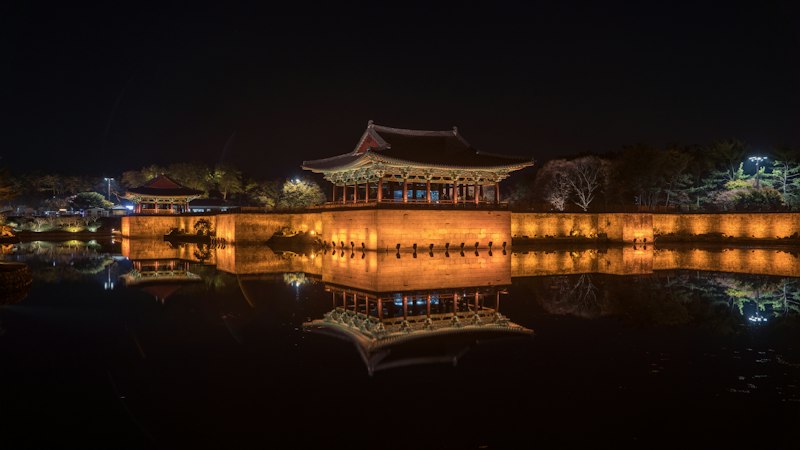
The night view at Wolji Pond is the best ending to a day in Gyeongju. The reconstructed palace buildings are illuminated from dusk, and their reflection in the still surface of the pond creates the defining image of the city. Arrive at sunset and stay until the crowds thin and the reflections sharpen.
Entry ₩3,000. The site is open until 10pm. If you can only stay one night in Gyeongju, the evening at Wolji Pond is why.
If You Have 2 Days
Planning a trip to Gyeongju?
Gyeongju is rarely the whole trip. The planner places it inside your wider route, with the KTX legs either side worked out. No sign-up needed.
Build My Gyeongju Plan →Two days in Gyeongju allows for depth rather than coverage — the same sites at a pace that lets the city arrive naturally.
Bulguksa Temple and Seokguram Grotto take four to five hours combined and anchor whichever day you give them to. The city-centre cluster — Gyeongju National Museum, Tumuli Park, Cheomseongdae — works as a single block, and Wolji Pond is worth holding until after dark, when the reconstructed pavilions are lit and reflected in the water.
The second day is what one-day visitors miss. Yangdong Folk Village is a UNESCO-listed traditional village about 15km north of the city, continuously inhabited since the Joseon dynasty, and the Bomun Lake Resort area east of the city suits a slower stretch by the water. Hwangnam bread — dense red bean pastries shaped like the city's burial mounds — is Gyeongju's signature food souvenir; buy a box near Tumuli Park before you leave.
For a complete budget breakdown of a multi-day trip across Korea — accommodation, transit, and daily meals at three levels — the Korea Travel Budget Guide 2026 covers every category.
Where to Stay
For a day trip from Busan, no accommodation is needed — the return journey takes thirty minutes. For a day trip from Seoul, the last KTX back departs in the mid-to-late evening, leaving enough time for Wolji Pond at night before returning.
For one or two nights, three base areas suit different priorities.
Near Gyeongju Station: The most practical choice for most visitors. Guesthouses and budget hotels here are affordable and well-placed for walking to Tumuli Park, Cheomseongdae, and Wolji Pond.
Near Bulguksa Temple: Quieter and more atmospheric, but removed from the city centre sites. Best for visitors who want to walk the temple grounds at dawn before the day-trippers arrive.
Bomun Lake Resort area: East of the city, with larger hotels and resort facilities. Suits families or visitors who want more comfort.
Traditional hanok guesthouses are available in the city centre and suit Gyeongju specifically — the historic context makes the traditional wooden architecture feel genuinely in place rather than staged.
Practical Tips
Getting around: City buses connect both Gyeongju Station and Singyeongju Station to all major attractions. English-language route information is posted at both stations. The 700-series buses handle the Singyeongju to Bulguksa route; buses 10 and 11 run from Gyeongju Station. The city centre sites — Tumuli Park, Cheomseongdae, Wolji Pond, and the National Museum — are all within walking distance of each other once you arrive in the centre.
Bicycle rental is available near Gyeongju Station for ₩5,000–₩10,000 per day. The flat terrain around Tumuli Park and Cheomseongdae makes cycling practical for the afternoon circuit. Avoid cycling to Bulguksa — the approach road is steep.
Night viewing: The evening illumination at Wolji Pond and the lighting at Cheomseongdae are among the finest night experiences in Korea. Both sites stay open until 10pm. For day-trippers from Busan, the 9:13pm KTX from Singyeongju leaves enough time for a full evening at Wolji Pond before a 9:45pm arrival back in Busan.
Best seasons: Spring brings cherry blossoms to the paths around Bulguksa in late March and early April. Autumn (October and November) turns the temple grounds gold and red. Winter is the quietest season and occasionally brings snow to the burial mounds — a transformation that makes the city feel even further from the present than it normally does.
Frequently Asked Questions
Is Gyeongju worth visiting on a day trip from Seoul?
Yes, but it requires an early start. The KTX takes about 2 hours each way, leaving roughly 6-7 hours to explore. A 1-night stay lets you see more without rushing.
How do I get from Busan to Gyeongju?
The KTX takes about 30 minutes from Busan, making Gyeongju one of the easiest day trips from the city. Regular trains also run but take longer.
What is Gyeongju famous for?
Gyeongju was the capital of the Silla Kingdom for nearly 1,000 years. It's known for Bulguksa Temple, Seokguram Grotto, ancient royal tombs, and the Cheomseongdae observatory.
How many days do I need in Gyeongju?
One full day covers the main highlights like Bulguksa and Tumuli Park. Two days allows time for Seokguram Grotto, the National Museum, and the night views at Donggung Palace and Wolji Pond.
Is Gyeongju easy to visit without a car?
Yes. City buses connect most major attractions, and bike rental is popular for getting around the flatter parts of the city near Tumuli Park.
Make a Gyeongju plan that fits your trip
Gyeongju is rarely the whole trip. The planner places it inside your wider route, with the KTX legs either side worked out. No sign-up needed.
Build My Gyeongju Plan →