Tongyeong Travel Guide 2026: Cable Car and Oysters
“Korea's longest cable car, Hallyeohaesang island views, Chungmu gimbap, and a harbor that has fed fishing communities for centuries.”
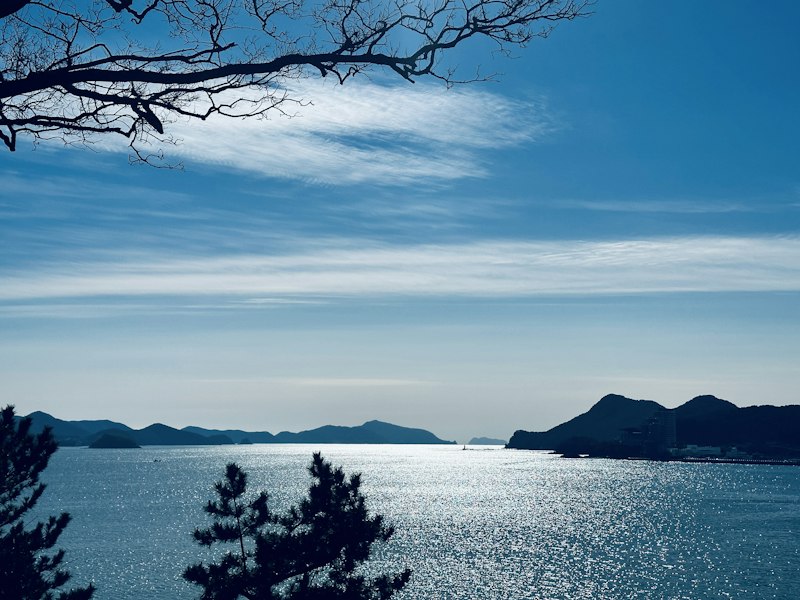
Tongyeong Travel Guide 2026: Cable Car, Oysters, and the Korea Strait Coast
Tongyeong sits at the southernmost tip of the Korean peninsula, where the Korea Strait fractures into dozens of islands, inlets, and channels that form Hallyeohaesang National Marine Park. It is not a city that announces itself loudly. Unlike Busan — its neighbor two hours north by bus — Tongyeong has no subway system, no international hotel corridor, and no beach that draws three million visitors a summer. What it has instead is a cable car that lifts you above one of the most beautiful maritime landscapes in Northeast Asia, a seafood market where oysters come off the boats every morning, and a hillside neighborhood whose community mural project saved an entire village from demolition.
The city was known as Chungmu until 1995, when it reclaimed its historical name. That older name survives in the food: Chungmu gimbap, the small rice-only rolls eaten with spicy squid and radish kimchi, originated here and remains the most identifiable dish in the city. A second historical layer runs deeper still: Admiral Yi Sun-sin, the Joseon-era commander who defeated Japanese naval forces in the 1590s Imjin War, fought several decisive engagements in the waters immediately surrounding Tongyeong. The island of Hansando, visible from the cable car summit and accessible by ferry from the main harbor, was the site of his most celebrated naval victory.
For visitors traveling from Busan, Tongyeong works cleanly as a full-day excursion. For travelers considering it as a standalone destination, the city rewards an overnight stay, particularly if oyster season (November through March) aligns with the travel dates. The Tongyeong city page covers neighborhoods and orientation; this guide focuses on getting there, what to see, and what to eat.
Getting to Tongyeong
Tongyeong has no KTX station and no direct rail connection. The city is reached entirely by bus — a fact worth confirming before building a rail-centered itinerary. The nearest KTX stops are Masan and Changwon Central, from which a local bus or taxi reaches Tongyeong in roughly 45 minutes, but this connection is rarely faster than a direct bus from Seoul or Busan and is not the recommended route.
| Departure | Service | Duration | Fare (one-way) |
|---|---|---|---|
| Seoul Express Bus Terminal (경부선, Lines 3/7/9) | Express / Deluxe | ~4h 10m | ₩21,800 / ₩32,400 |
| Seoul Nambu Terminal (남부터미널, Line 3) | Nonstop | ~4h 10m | ₩24,600 |
| Busan Seobu Terminal (사상역, Line 2) | Intercity Bus | ~1h 30m | ~₩16,700 |
*Fares based on published schedules as of 2026. Deluxe (우등) buses from Seoul include reclining seats and extra legroom — worth the difference on a four-hour journey. Buses from Seoul run approximately every 30 minutes throughout the day.*
From Seoul, buses depart from the Gyeongbu side of Seoul Express Bus Terminal (경부고속버스터미널), which is accessible by subway Lines 3, 7, and 9. Seoul Nambu Terminal (남부터미널, Line 3) operates a competing nonstop service to Tongyeong at a slightly higher fare. For online booking, the KoBus website handles both terminals in English. The regional transit guide covers the KoBus booking process and the difference between Express and Intercity bus networks for travelers unfamiliar with the distinction.
From Busan, buses depart from Busan Seobu Terminal (부산 서부터미널), also called Sasang Terminal, reached via subway Line 2 to Sasang Station (사상역). Services run approximately every 20 minutes and the journey takes around 1 hour 30 minutes. The Busan travel guide covers Busan's bus terminals and transit layout for visitors approaching from that direction.
Hallyeosudo Cable Car (한려수도 케이블카)
Korea's longest cable car at 1,975 metres carries passengers from the base station in Donam-dong to the summit observatory of Mireuksan (미륵산, 461m) in approximately nine minutes. What opens below you as the cabin rises is not a single vista but an entire seascape: dozens of islands scattered across Hallyeohaesang National Marine Park, Geoje Island visible to the east, the Tongyeong harbor compressed to a crescent of water below, and on clear days the open Korea Strait extending to the horizon.
The summit observatory has two levels. The lower level is enclosed and sheltered; the upper deck is open to wind and light. Both directions give you the same spatial fact — the density of islands visible from this elevation — but the upper deck delivers it without glass between you and the air. Clear days between October and April produce the most definition across the island chain, when coastal haze is minimal.
Adult round-trip fare is ₩17,000; children ₩13,000. Operating hours are 10:00–17:30 on weekdays and 10:00–18:00 on weekends, with seasonal variation. The cable car closes for maintenance on occasional weekday mornings — confirm the schedule on the official website or by phone before visiting if you are planning the day around it.
Skyline Luge Tongyeong
Adjacent to the cable car upper station, Skyline Luge Tongyeong operates a gravity-powered luge track descending from the Mireuksan summit area. The luge is a small open cart steered by a handle mechanism — slow means pull back, fast means push forward — and the track runs on dedicated concrete channels with banked corners and long downhill straights that follow the mountain contour.
Packages start from approximately ₩39,000 for four luge rides on Klook, with a separate Skyride chairlift required to return to the launch point after each descent. The standard sequence — cable car up, luge partway down, Skyride back up, luge again — takes around 90 minutes. Advance online purchase is recommended on weekends and during Korean school holidays when same-day queues at the upper station run significantly longer.
Dongpirang Mural Village (동피랑 벽화마을)
In 2007, the Tongyeong city government announced plans to demolish Dongpirang — a hillside neighborhood of old homes and steep lanes above the old harbor — and replace it with a public viewing platform. A local arts organization responded by inviting street artists to cover the village's walls with murals before any demolition could proceed, framing the paintings as a preservation argument rather than a protest.
The campaign drew national media attention. The murals were painted. The demolition plan was shelved. Dongpirang became one of the south coast's most recognized neighborhoods and has been maintained as an active mural village since, with periodic repainting by local and invited artists.
The paintings cover stairway walls, house facades, alleyway floors, and roofline edges across the neighborhood. Themes range from folk illustration motifs to contemporary graphic work to abstract color fields. The village is still actively residential — people live in these homes — which gives the place a weight that purpose-built art districts tend to lack. The harbor views from the upper lanes, looking down over the Gangguan basin and out toward the island chain, are among the best available in the city.
Allow 45 minutes to an hour for a thorough walk. Entry is free.
Gangguan Harbor and Jungang Market (강구안/중앙시장)
Gangguan is Tongyeong's old harbor — the semicircular bay at the center of the city where fishing boats dock, ferry services depart, and the morning catch arrives before most of the city wakes up. The fish market activity begins before dawn when trawlers return from overnight runs, and the unloading and trading that follows has retained its essential character across generations of the city's life as a fishing port.
The Jungang Market (중앙시장), immediately adjacent to the harbor, is where the catch arrives for retail sale: shellfish in styrofoam under ice, octopus in tanks, whole fish arranged by species and size, prices marked by the kilogram and negotiated by the handful. Harbor-adjacent haengsik restaurants cook the market's produce on tabletop grills at the tables where you eat — seafood BBQ in Tongyeong, oysters and clams and squid cooked over charcoal, with kimchi and pickled vegetables on the side, costs significantly less here than the equivalent spread in Seoul or Busan.
The Jungang Market is also the origin point of Tongyeong's two most famous street foods, covered below.
Hansando Ferry (한산도)
Planning a trip to Korea?
Answer a few quick questions and get a personalized day-by-day itinerary — cities, food, and transit included. No sign-up needed.
Build My Korea Plan →Hansando Island lies roughly 14 kilometres southwest of the harbor, and it is where Admiral Yi Sun-sin's fleet defeated the Japanese naval force of Wakisaka Yasuharu in August 1592 — the Battle of Hansando, one of the pivotal engagements of the Imjin War. The ferry departs from Gangguan Harbor and takes approximately 25 minutes each way.
On the island, the main landmark is Jeseungtang (제승당), a memorial hall and small historical complex marking the site where Yi Sun-sin maintained his command post during the campaign. The surrounding coastline is quiet and largely undeveloped, and the crossing gives you a view of the strait that makes the scale of the naval campaign legible in a way that museum maps cannot.
Check the return ferry schedule before crossing — services run several times daily but the last departure from the island is typically in the mid-to-late afternoon.
Chungmu Undersea Tunnel (충무해저터널)
The Chungmu Undersea Tunnel connects the main Tongyeong peninsula to Mireuk Island (미륵도) — where the cable car base station is located — beneath the harbor mouth. Built in 1932, it is recognized as Asia's first undersea road tunnel, predating comparable structures elsewhere on the continent by decades.
The tunnel is 461 metres long. A pedestrian walkway running alongside the road allows visitors to cross on foot in about seven minutes. The passage itself is low and functional — concrete walls, period lighting, signage in Korean — with no dramatic views. The reason to walk it is the historical fact of where you are: underground, beneath a working harbor, through a structure that stood when most of Asia's undersea infrastructure had not yet been built.
Tongyeong's Three Essential Foods
<strong>Chungmu Gimbap</strong> (충무김밥) is the dish most clearly specific to this city. Unlike the Seoul version — a large roll packed with egg, vegetables, and seasoned protein — Chungmu gimbap is made with rice only, wrapped tightly in a short cylinder of dried seaweed, and served plain. The flavors that would normally go inside arrive separately: spicy stir-fried squid (낙지무침) and radish kimchi (깍두기) in small dishes alongside.
The origin is practical rather than aesthetic. Tongyeong's fishing families needed food that would not spoil on boats during summer. A plain rice roll kept longer than an integrated filling; the squid and radish component, properly fermented, lasted even longer in a separate sealed container. The two are eaten together: a bite of gimbap, a bite of squid, alternating until both are gone. A full set at Jungang Market costs ₩4,000–₩6,000 and constitutes a complete meal.
Tongyeong accounts for <strong>roughly 70–80% of South Korea's domestic oyster harvest</strong>, a proportion that reflects the city's geographic position in the productive waters of the Korea Strait. Oyster season runs November through March, when water temperatures are low enough to produce clean, dense-textured shells. A plate of raw oysters at the Jungang Market costs ₩10,000–₩20,000 depending on size and quantity. Outside season, oyster rice (굴밥) and grilled oysters (구운 굴) are available year-round from harbor restaurants.
Kkul-ppang (꿀빵) is Tongyeong's edible souvenir: a doughnut-shaped pastry filled with sweet red bean paste and finished with a honey syrup glaze. It originated at a bakery in the Jungang Market area and has since spread to multiple vendors selling competing versions. The essential format is the original — dense, sweet, best eaten warm from the shop. Sesame, black bean, and walnut variations exist for repeat visitors.
A One-Day Itinerary from Busan
The following sequence assumes an early bus departure from Busan and a full day on the ground before an evening return.
07:30 — Bus from Busan Seobu (Sasang) Terminal. Arrive Tongyeong ~09:00.
09:15 — Taxi from Tongyeong Bus Terminal to the cable car base station (~5 minutes, ~₩5,000). Take the Hallyeosudo Cable Car to the Mireuksan summit. Skyline Luge on the descent if time permits.
12:00 — Walk through the Chungmu Undersea Tunnel from Mireuk Island to the main peninsula (free, 7 minutes on foot).
12:30 — Lunch at Jungang Market: Chungmu gimbap set, raw oysters, or a harbor haengsik restaurant for seafood BBQ.
14:00 — Walk to Dongpirang Mural Village (10 minutes from the market on foot). 45–60 minutes.
15:30 — Optional: ferry to Hansando from Gangguan Harbor. Check the last return departure before boarding.
17:30 — Return to bus terminal by taxi (~₩5,000). Bus back to Busan.
For navigation between sites, Naver Map handles all routing in English and shows real-time taxi availability. In Tongyeong, where bus frequency drops sharply in the afternoon, Kakao T is the practical backup for flagging taxis. The essential travel apps guide covers both.
Practical Tips
Season matters most for food: oyster season (November–March) is when the market is at its best and the harbor activity most visible. Cable car views are clearest in autumn and winter when coastal haze is absent. Summer brings the longest daylight hours and the most comfortable ferry crossings.
Getting around: the main sites are spread across several kilometres and are best connected by taxi. T-Money cards work on local buses, but service frequency between the harbor, cable car base, and market is low enough that taxis are the practical choice. Budget ₩5,000–₩10,000 per taxi leg within the city.
Cash: Jungang Market vendors and smaller seafood restaurants typically prefer cash. Carry ₩50,000 minimum for a full market day that includes raw oysters and a proper meal.
Frequently Asked Questions
How do I get from Seoul to Tongyeong?
Take an express bus from Seoul Express Bus Terminal (Lines 3/7/9) or Seoul Nambu Terminal (Line 3). The journey takes approximately 4 hours 10 minutes. Fares run ₩21,800 for a standard express service, ₩24,600 for the nonstop service from Nambu Terminal, or ₩32,400 for a deluxe reclining-seat bus. Tongyeong has no KTX station — bus is the only direct long-distance option.
How long does it take to get from Busan to Tongyeong?
Buses from Busan Seobu Terminal (Sasang, Line 2) reach Tongyeong in approximately 1 hour 30 minutes. The fare is around ₩16,700 one way. Services run roughly every 20 minutes throughout the day.
What is Chungmu gimbap?
Chungmu gimbap is a style of gimbap that originated in Tongyeong (formerly called Chungmu). Unlike standard gimbap, the rolls contain only plain white rice wrapped in seaweed — no fillings inside. They are served alongside spicy stir-fried squid (낙지무침) and radish kimchi (깍두기) in separate dishes. The format originated with Tongyeong fishing families who needed boat food that would not spoil in summer heat. A full set costs ₩4,000–₩6,000 at Jungang Market.
When is the best time to visit Tongyeong for oysters?
Oyster season in Tongyeong runs November through March, when cold Korea Strait water temperatures produce the cleanest, densest-textured shells. Tongyeong accounts for roughly 70–80% of South Korea's domestic oyster harvest. At Jungang Market, a plate of raw oysters costs ₩10,000–₩20,000 during season. Outside season, oyster rice and grilled oysters are available year-round.
Is Tongyeong worth visiting from Busan as a day trip?
Yes. The bus from Busan Seobu Terminal (Sasang) takes about 1 hour 30 minutes each way, leaving a full day for the Hallyeosudo Cable Car, Dongpirang Mural Village, Jungang Market, the Chungmu Undersea Tunnel, and an optional ferry to Hansando. The combination of scenery, food, and maritime history makes Tongyeong one of the more rewarding south coast day trips from Busan.
Make a plan that fits your trip
This guide gives one version. Get one built around your own dates, budget, and interests — with Korean place names you can paste straight into Naver Map. No sign-up needed.
Build My Korea Plan →